
Functional Medicine
Men's Health
Low energy. Brain fog. Muscle loss. Weight gain. Your doctor says your testosterone is 'in range.' But you feel like a shadow of who you were five years ago. We test what they skip and build a protocol that gets you back.

Why Your Doctor Keeps Saying 'You're Fine'
You used to have energy. You used to sleep well. You used to feel sharp at work and strong in the gym. Now you're dragging by 2pm, putting on weight around your midsection, losing muscle even though you're still training, and your motivation has flatlined.
So you go to your doctor. Maybe they run a testosterone test. And they tell you your level is "within normal range." You're at 320 on a scale of 300 to 1,000. Technically normal. But that doesn't explain why you feel terrible.
Here's the problem. The reference ranges on standard lab work are based on population averages, not on what's actually optimal for your body. A testosterone of 320 is "normal" the same way a D-minus is a passing grade. You're not failing, but you're nowhere near where you should be.
Men lose roughly 1 to 2 percent of their testosterone per year after age 30 to 35. That decline is gradual enough that you don't notice it happening. You just slowly become a worse version of yourself, year after year. And because your numbers still fall within the standard range, your doctor has no reason to treat you.
The conventional medical system is built to catch acute illness. It's excellent at emergencies. But it was never designed to help you feel optimal. That's the gap. Longevity, performance, and quality of life sit in a space that insurance-based medicine simply doesn't address.
“A man in his early 40s comes in with a testosterone of 320. His conventional doctor says, 'You're totally fine.' But he's not, though. That's the thing.”
Colin Renaud, PA-C on Why Testosterone Gets Missed
Provider Insight
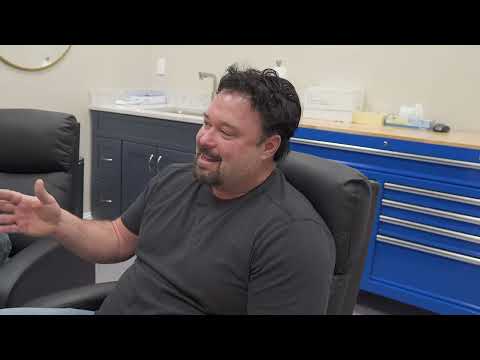
“My old level was really probably closer to my baseline. And if you take that and cut it in half, even though my half was still in what medical professionals say is an acceptable range, that's not necessarily what's acceptable for my body.”
Ryan: Why 'Normal Range' Wasn't Normal for Him
Patient Story
“My old level was really probably closer to my baseline. And if you take that and cut it in half, even though my half was still in what medical professionals say is an acceptable range, that's not necessarily what's acceptable for my body.”
Ryan: Why 'Normal Range' Wasn't Normal for Him
Patient Story
“I wake up and not feel that, you're like, 'Wow.' My quality of life is completely different.”
Caleb: Quality of Life Completely Changed
Patient Story
Inside Med Matrix
Everything Under One Roof
Advanced testing, personalized protocols, and real results from a team that treats the whole picture.

4.9
from 150+ Google Reviews
How Med Matrix Treats Men's Health
We don't just check your testosterone and hand you a prescription. We look at the full picture.
Your first visit is a 30-minute testing appointment where we draw a panel of roughly 100 biomarkers and run a full InBody 770 body composition scan. We're looking at far more than testosterone.
What we test:
- Total and free testosterone
- Estrogen (estradiol) and prolactin
- Full thyroid panel (TSH, free T3, free T4, reverse T3, antibodies)
- Cortisol and stress hormones
- Fasting insulin, glucose, HbA1c (metabolic health)
- Inflammatory markers (CRP, ESR)
- Vitamin D, B12, ferritin, magnesium, zinc
- Cholesterol panel
- Body composition (lean mass, visceral fat, hydration)
Why does all of this matter? Because testosterone doesn't exist in a vacuum. If you're insulin resistant, stressed out, sleep-deprived, vitamin D deficient, or dealing with thyroid dysfunction, just adding testosterone won't fix the problem. You'll feel better for a while, then plateau. The one-stop-shop testosterone clinics that hand every guy the same dose miss all of this.
Colin Renaud, PA-C, one of our lead providers, puts it bluntly: the conventional medical model doesn't address longevity. Hormone optimization is simply not part of the philosophy. That's why men with clear symptoms walk out of their doctor's office empty-handed.
At Med Matrix, your provider reviews your full panel, your health history, your lifestyle, and your goals before you sit down for a one-hour visit. Your treatment plan might include testosterone replacement therapy, but it also addresses everything else that's dragging your levels down: stress, sleep, diet, nutrient deficiencies, and metabolic dysfunction. That's how you get results that last.
For younger men concerned about fertility, we offer alternatives like enclomiphene, an oral medication that raises testosterone naturally without suppressing sperm production. Your age, your goals, and your labs all factor into the plan we build for you.

“A man in his early 40s comes in with a testosterone of 320. His conventional doctor says, 'You're totally fine.' But he's not, though. That's the thing.”
Colin Renaud, PA-C on Why Testosterone Gets Missed
Watch at 7:00→
“My old level was really probably closer to my baseline. And if you take that and cut it in half, even though my half was still in what medical professionals say is an acceptable range, that's not necessarily what's acceptable for my body.”
Ryan: Why 'Normal Range' Wasn't Normal for Him
Watch at 2:35→The Med Matrix Process
How It Works
Your path to feeling like yourself again, step by step.
Discovery Call
Free consultation
Biomarker Test
80+ markers
Team Review
Full analysis
Consultation
60 minutes
Ongoing Support
Continuous care
Free Discovery Call
- Talk with our patient coordinator about your goals, symptoms, and concerns
- Understand your options and what to expect
- Get matched with the right provider for your needs
Result: A clear next step personalized to your situation, with no pressure or commitment.
80+ Biomarker Test & Full Body Scan
- Comprehensive panel of 80+ lab markers
- Full body composition scan
- In-depth health questionnaires
Result: A complete picture of your health, so nothing gets missed.
Medical Team Reviews Everything
- Providers review your labs, medical history, and questionnaires
- Cross-reference symptoms with biomarker patterns
- Identify root causes, not just surface symptoms
Result: A personalized treatment plan built from real data, not guesswork.
60-Minute Provider Consultation
- Sit down with your provider for a full hour
- Go over every result in detail
- Build your personalized plan together
Result: You leave with a clear understanding of what is happening and exactly what to do about it.
Ongoing Support & Progress
- Continued monitoring of your labs and markers
- Adjustments to your plan as your body responds
- Direct access to your care team
Result: Real, measurable progress you can feel and see in your numbers.
Real Patients, Real Results
Ryan had been feeling a steady decline for about two years. Energy dropping. Afternoon crashes so bad he needed a nap by 2pm. Libido fading. Losing muscle despite staying active. His primary care ran a testosterone test and said it was still in the acceptable range, even though it had dropped to about half of his personal baseline. They declined to treat it.
At Med Matrix, a full blood panel revealed multiple deficiencies. He started a supplement protocol and testosterone replacement therapy. Within about four weeks, his libido improved, the afternoon wall disappeared, and his cognitive clarity came back.
Caleb, who owns a hardscape business, came in with tanked testosterone, no energy, chronic back and knee pain, and a body that was breaking down from years of physical work. After about three months on his protocol, his energy and mood improved, his pain levels dropped significantly, and his recovery from a rotator cuff surgery was so fast that his surgeon filmed his range of motion at the six-week post-op visit.
These stories aren't exceptions. We've served over 3,000 patients at Med Matrix with a 4.9-star rating across 150+ Google reviews. Most of the men who come in have been told by at least one doctor that nothing is wrong.
“My old level was really probably closer to my baseline. And if you take that and cut it in half, even though my half was still in what medical professionals say is an acceptable range, that's not necessarily what's acceptable for my body.”
Ryan: Why 'Normal Range' Wasn't Normal for Him
Watch at 2:35→
“I wake up and not feel that, you're like, 'Wow.' My quality of life is completely different.”
Caleb: Quality of Life Completely Changed
Watch at 4:10→Free Resource
Get Your Free Practice Guide
Includes a $100 voucher toward your first visit
Everything you need to make an informed decision: pricing, testing catalog, process timeline, provider bios, and real patient stories. No commitment required.

Free Practice Guide + $100 Voucher
Everything you need before your first visit
STEP 1 OF 3
Where can we send your practice guide?
Enter your email to get instant access
We only accept a limited number of patients per week
EXPLORE
Related Content
Articles, patient stories, and podcast episodes about men's health.

FAQ
Men's Health FAQ
We run roughly 100 biomarkers including total and free testosterone, estrogen, prolactin, full thyroid panel, cortisol, fasting insulin, glucose, HbA1c, inflammatory markers, vitamin D, B12, ferritin, magnesium, zinc, cholesterol, and more. You also get an InBody 770 body composition scan. Testosterone is one piece. We look at everything that affects how your body produces, uses, and responds to hormones.
Testosterone-only clinics typically give a standardized dose to every man who walks in. They don't look at insulin resistance, thyroid function, nutrient deficiencies, cortisol, or lifestyle factors. They also tend to prescribe estrogen blockers by default, which most men don't actually need. We build a plan around your full health picture, not just one hormone. That's why our results last.
Initial onboarding is about $1,200 to $1,500 all-in, covering your blood panel, body composition scan, provider prep time, and your full one-hour provider visit. Follow-up visits are $275. Supplements are typically $20 to $100 per month, and testosterone therapy runs $70 to $200 per month. We accept HSA, FSA, CareCredit, and all major cards. New patients get a $100 voucher toward their first visit.
Insurance will cover TRT in some cases, but only when levels are extremely low (often below 300). If you're at 320 and feel terrible, insurance says you're fine. We operate outside the insurance model so we can treat you based on how you actually feel and what's optimal, not just what qualifies for a billing code. We accept HSA and FSA accounts, CareCredit, and all major cards.
Most men start noticing changes within four to six weeks. Libido and afternoon energy tend to improve first. Cognitive clarity, motivation, and mood improvements build over the following months. Body composition changes (more muscle, less fat) take longer, typically three to six months. We recheck labs at about 10 weeks to see how you're responding and adjust from there.
Yes. For younger men who want to preserve fertility, we use alternatives like enclomiphene, an oral medication that raises testosterone naturally by stimulating sperm production. Because testosterone and sperm are made in the same cells, boosting sperm production indirectly raises your testosterone without suppressing your body's natural production. Your age, fertility goals, and lab results all factor into the plan we build for you.
Related Services to Men's Health

Your Health, Your Terms
Start Feeling Like Yourself Again
Get your free practice guide and a $100 voucher toward your first visit. No commitment, no pressure.